
Shipping and logistics
What you (maybe) did not know about cash on delivery …
20 January 2022
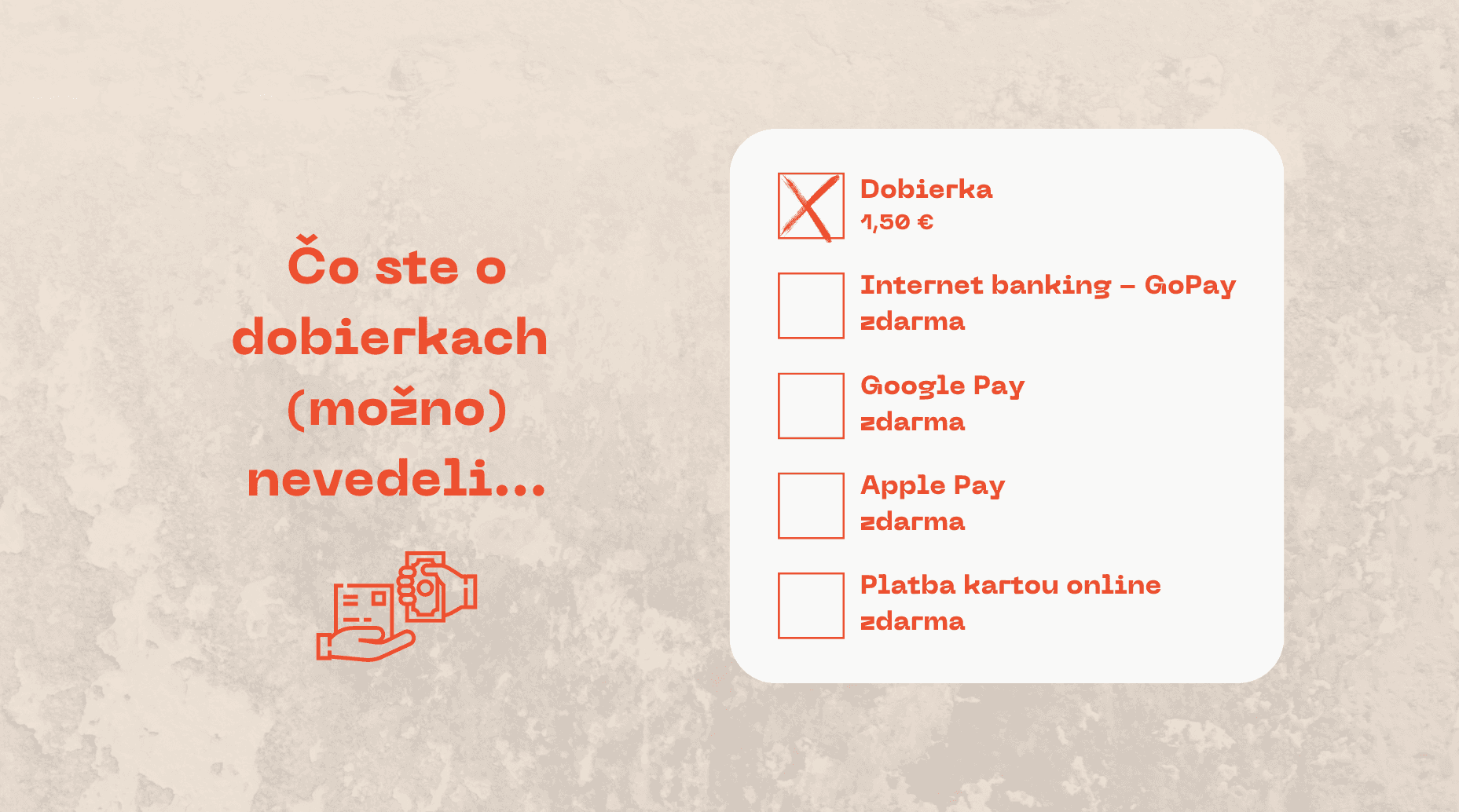
COD has its pitfalls – card fees, uncollected shipments and cashflow. Let us look at the details.
Cash on delivery is a term thrown around a lot in the waters of e-commerce and logistics, and its existence gives more than one e-shop a headache. Let us be honest – it is expensive and its price rises every year. On top of that it means a lot of work matching incoming payments with issued invoices. Quite simply, we would all like payments in advance without needless complications …
If you are not one of those lucky ones, though, and send most of your parcels cash on delivery, it is definitely worth paying attention for a moment. We have a few examples to help you understand how it is charged, plus several tips and recommendations on how best to deal with it.
Cash vs. card payment
Many of you may not realise it, or simply did not know, but whether your customer pays the COD amount in cash or by payment card makes a considerable difference. Transport companies (mostly) charge a transaction fee for card payments. It can range from 0.9 % to 1.4 % of the COD amount. The final price for a collected COD amount paid by card is therefore calculated by adding a percentage surcharge, worked out from the COD amount, on top of the COD fee. We will illustrate this with two simple examples:
Example 1:
- The carrier charges you 0.80 € for a cash COD payment.
- It also charges a surcharge for card payment, namely 1.1% of the total COD amount.
So if you send a parcel with a COD amount of 80 €, for example, and your customer pays in cash, you will pay the carrier (only) 0.80 €. But if the customer chooses to pay by card, you will pay the carrier {(0.80 € + (0.011 x 80)} = 1.68 €. That is more than the COD fee itself and it is worth thinking about what you can do with it.

Minimal differences per unit can add up to tens or hundreds of euros in your total monthly costs.
Example 2:
- The carrier charges you 0.80 € for a cash COD payment.
- It also charges a surcharge for card payment, namely 1.1 % of the total COD amount.
- You dispatch 500 parcels a month with an average COD value of 80 €.
- The share of parcels sent cash on delivery is 80 %, i.e. 400 parcels.
If those 400 dispatched parcels were paid in cash, you would pay the carrier for COD in total: (0.80 € x 400) = 320 €. If those 400 dispatched parcels were paid by card, you would pay the carrier for COD in total: [(0.80 x 400) + {(80 x 0.011) x 400}] = 320 + 352 = 672 €
With these 2 examples we did not want to show off how well we can count. We wanted to use them to point out how important a regular analysis is, because it can answer why such big price differences arise between your parcels. And the answer may lie precisely in the COD surcharges, and even more so in card payments.
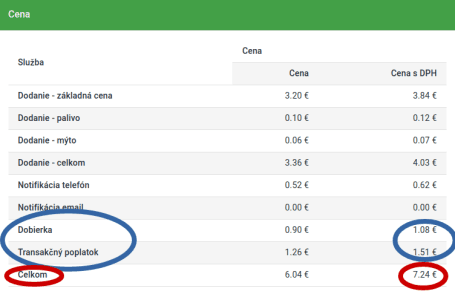
For a complete overview and easy orientation in prices, we show our Neoship customers the final price for every parcel as well as its individual items (including COD fees):
The final price per parcel:

The individual items in the price per parcel:
Growth potential
The use of card payments is growing significantly year on year, partly because of the pandemic measures. To back up the above, we can add information from the carrier GLS, which in the first half of 2019 recorded 5 % of all COD parcels paid by card. In the first half of 2021 it was already 27 %. We assume these numbers will only rise as the Covid situation continues.
Stopping card payments
With some carriers you can ask for card payment of COD to be „stopped”. When deciding whether to go for this option or not, weigh up all the pros and cons very carefully. You will save on costs, but on the other hand you may lose a customer who, because of this restriction, may not buy from you again. And if you do decide to stop card payments, tell your customers about it – clearly enough, in good time and in a visible place (a „big red notice” in the cart when the customer is choosing the delivery method can help, for instance). Keeping people informed will certainly prevent a lot of problems in the form of angry phone calls or reviews.
Our recommendation

To reduce the share of COD parcels and the related transport costs, you can, for example, charge a substantial fee for COD in the cart, either across the board or from a certain order value up. Motivate your shoppers to use a payment gateway or online card payment more often, if that payment method works out better for you given the related fees.
Of course, it is not all about COD. COD is only part of the price per parcel. And the price per parcel is in turn only one part of your total dispatch costs. We wrote more about it in the article The cost of dispatch = the price per parcel? But if you are keen to improve and streamline the processes inside your e-shop, you have to go about it step by step – for example with a detailed analysis of your COD payments. We hope you will put our information to good use if you decide to do one. Fingers crossed :)
We wrote more about COD and other topics related to dispatch and logistics in our e-book, Step by step to the right dispatch solution. And the great thing is, the e-book is completely free to download.