
Shipping and logistics
How do you set the right postage price in your e-shop?
22 May 2020
The postage price affects both conversions and profit. How to set it so the customer buys and you do not lose out.
How do you set the right postage price in your e-shop? One of the most common questions we come across at business meetings. Although setting the postage price in an e-shop may look simple at first glance, it does not have to be.
You should pay extra attention to this topic if you do not want to lose customers because your postage is more expensive than the competition's, or if you want to know how much money you are losing by subsidising it.
We recently published a post on our FB page about 7 facts related to shipping and postage in an e-shop. As they are relevant to this topic, we are repeating them here. We „borrowed“ the facts about postage below from research by Transportation Insight, while we took the liberty of adding the seventh one as our own observation from several years' experience in logistics and dispatch.
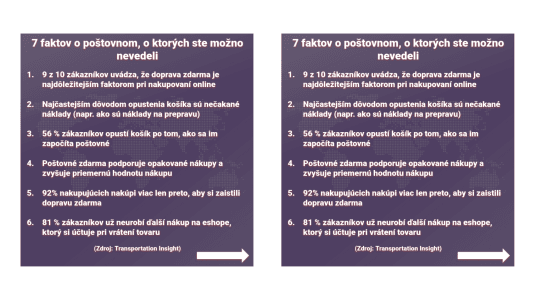
Following on from these facts we put together two questionnaires to find out how e-shops currently approach setting postage and how shoppers perceive the postage price.
The questionnaire for e-shop shoppers and the interpretation of its results
The aim of the questionnaire was to find out whether a slightly higher shipping price puts shoppers off buying from their favourite e-shop, and at the same time which factor most influences their buying behaviour. With this questionnaire we managed to collect 40 answers.
Question 1 and the interpretation of the results
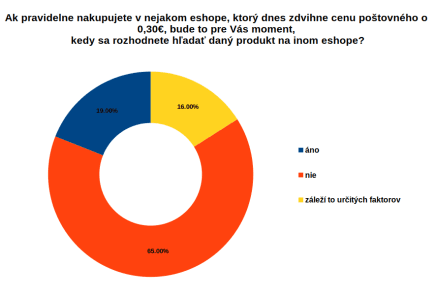
This example nicely shows that if a customer likes to shop at a particular e-shop and does so often, more expensive postage will not put them off buying. Regular purchases and a good experience with the e-shop are exactly the element that keeps a shopper from leaving and looking for the goods at another e-shop. If we are talking about 30 cents, a customer will not leave you over it.
When we set this question we expected such a result. We are glad our assumption was confirmed. Why? Over the last two years a lot has changed on the logistics market. One of the most significant changes was certainly the price increases at all transport companies, which of course hit e-shops hardest. Fearing they would lose customers because of higher transport costs, they tried to negotiate the lowest possible prices with their carrier. What happened? Carriers raised prices. Individually for everyone. By a few cents per parcel.
The price increases affected us too, and therefore our customers as well. It mattered to us that we got through this situation together. Around 5 % of e-shops stopped using our services because of the higher prices, which of course does not make us happy. Our experience, though, is that the others – those who accepted the carrier's increased prices and passed them on to customers, or did not change their postage at all – lost nothing. They still run their e-shops and their orders are at least at the numbers they were used to, or have grown.
Question 2 and the interpretation of the results
What determines your decision to buy from an e-shop? (1 – the most important factor, 8 – the least important factor)
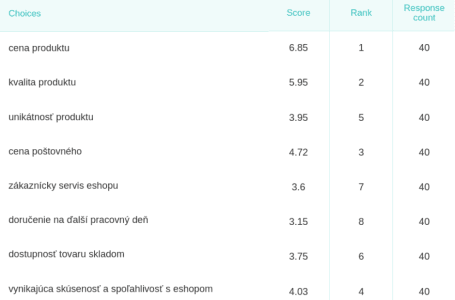
The survey results showed that when deciding on a purchase, the most important factor for shoppers is still the price of the product, followed by its quality, with the postage price in third place. The first two are probably obvious to everyone – we all want quality goods at a reasonable price. In third place is the postage price, which is a fairly high placing given the other factors listed. That placing confirms exactly what we said at the beginning of this article, namely that you should definitely pay close attention to your postage price. We would also draw your attention to the minimal difference between 3rd and 4th place, where right after postage the most points went to an excellent, reliable experience with the e-shop. So do not forget this significant factor either.
How to set the right level of postage so that you do not lose customers and at the same time are not out of pocket subsidising it, you can read further down the article.
The questionnaire for e-shop operators and the interpretation of its results
To get answers from relevant respondents, we asked members of the Facebook group Učíme sa podnikať s eshopom to fill in the questionnaire. Our tally ended at 30. We would like to thank everyone who made it possible for us to share the results of this questionnaire with you.
Question 1 and the interpretation of the results
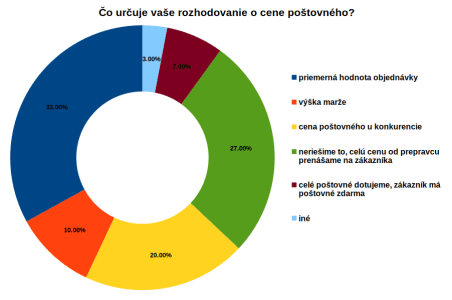
We recorded the results as percentages. As you can see in the chart, the most common aspects e-shops base their decision about the postage price on are above all the average order value, leaving the postage payment to the customer, and the competition's postage price. According to our survey, the least popular is free postage, where the e-shop subsidises the entire transport, or setting the price in a way other than the options listed. Since this question was answered by owners of e-shops with various focuses, it is clear that each of them approaches postage differently, depending on the size of the e-shop, the nature of the products and competitiveness.
More about which strategy to choose for your e-shop so that the customer does not abandon the cart and completes the purchase, you can read further down the article.
Question 2 and the interpretation of the results
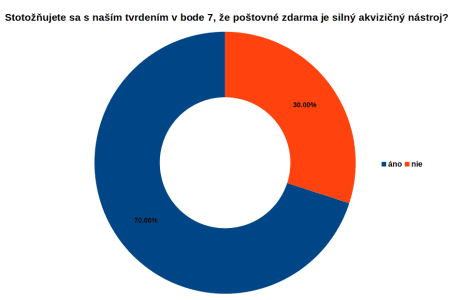
As many as 70% of respondents agree with our claim that free shipping or postage is worth including and thinking about in the category of marketing costs. We asked this question deliberately, because we wanted to find out how e-shop owners themselves see this tool. We are pleasantly surprised by the survey result, because we often come across this argument at our business meetings and when comparing quotations.
Strategies for setting postage
Strategy 1: The simplest, but for the e-shop the most expensive way – „free postage“
The idea of free postage is toyed with above all by e-shops whose goods are highly competitive. With easily available goods a customer can abandon the cart very quickly precisely because of postage and will look for the item elsewhere at a lower price or with free shipping. If you decide to go the free postage route, you have several options for how to handle it:
Absorbing the transport costs
A very simple solution, but a very expensive one. Few e-shops could afford this strategy in full. To be honest, this strategy is usually combined with others and assessed with regard to a product's margin or the total order value, for instance.
Passing the shipping cost into your product prices
On your website you can promote free postage, while in reality the customer pays for it in the increased price of your product (in which case you of course have to keep the product price competitive). You can increase product prices with a fixed surcharge, or use different surcharges for individual types of parcels, weights or total order values. A decision like this should definitely be preceded by an in-depth analysis to find out what your average postage costs are. In that case you should never end up out of pocket on postage. You can also choose a happy medium, where you absorb part of the shipping cost and let the customer pay the rest. So thinking about postage is different for an e-shop where parcel weights range from 1 to 2 kg than for one where the products vary and weights run from 1 kg to 30 kg.
Making it conditional on a minimum purchase or order value
This is the happy medium between the two previous options. As the survey showed, customers appreciate free shipping, but it is also scientifically proven that they like discounts, and on the other hand you do not want to bear all the transport costs. The best approach is therefore to stagger the postage price by order value.
Example: a clothing e-shop where the average price of one item of clothing is up to 20 euros. Order value from 0 – 25 € = postage price: 4.50 € incl. VAT + COD Order value from 25.01 – 60 € = postage price 2.25 € incl. VAT + COD Order value over 60 € = postage and COD free A motivating slogan such as „Get free shipping or 50% off your postage when you spend over 25 €” can have a significant positive effect on the number of orders, the total purchase value and on reducing how much you subsidise transport.
Free postage is a powerful incentive to buy. If that is your case, this information should definitely not stay hidden until the moment of payment. Quite the opposite. Boast about it, promote it and get ahead of the competition. Let it be the first thing a buyer sees on your e-shop.
Strategy 2: 1:1
The second option you can go for is letting the customer pay for the entire transport. In that case you do not have to agonise much over what price to set in the cart. You should definitely use this strategy if your product is unique. But do not be afraid to go for this alternative even if your products are offered by the competition too.
What do we recommend?
Try things out. Test. Combine. You may decide on a strategy today and find out after a while that the reality is different and does not meet your expectations. Whatever your decision, we keep our fingers crossed that customers buy from you not because of low or free postage. The reason a shopper should buy from you is not the postage price, but everything else. They do not type „the e-shop with the lowest shipping price” into a search engine or a price comparison site – they look for your product and expect great service at a reasonable price.
In closing we would like to highlight the current trend in logistics on this topic, namely rising prices. The prices of transport services are rising and will keep rising. A seasonal surcharge during the Christmas period is also becoming the rule at all transport companies in Slovakia. That trend will significantly affect the postage price for your customers. It is therefore important to prevent dissatisfaction or abandoned purchases by educating and informing customers about why the delivery price is higher (compared with the usual period). Although paying higher postage is nothing positive, a customer accepts the fact more easily if you explain why you are charging more for it.
If you would like a consultation in this area, or if we could help you with dispatch-related processes, we will be glad if you write to us or contact us on 0911 767 404.